Team Lead Proficient — run the portfolio like a PMO
Goal: think in flows, not tasks. Watch the leading indicators — Audit Log velocity, Approvals backlog, level-up cadence, Feedback Register burndown — and intervene before lagging metrics rot.
You arrive here after Advanced. You can govern a project. The next step is governing several at once, with the same discipline and without burning out. This is the work of a Programme Manager or PMO Director.
Why this tier matters
At this level, you stop being measured by what you do. You're measured by what your system does without you. A great PMO operator can take a two-week vacation and the projects still progress because the cadence is set, the standards are clear, and the data flows are instrumented.
dooer's value to you stops being "place to track tasks" and becomes "instrumentation layer for the work I'm responsible for."
The 9 journeys
T-3.1 — Build a portfolio view
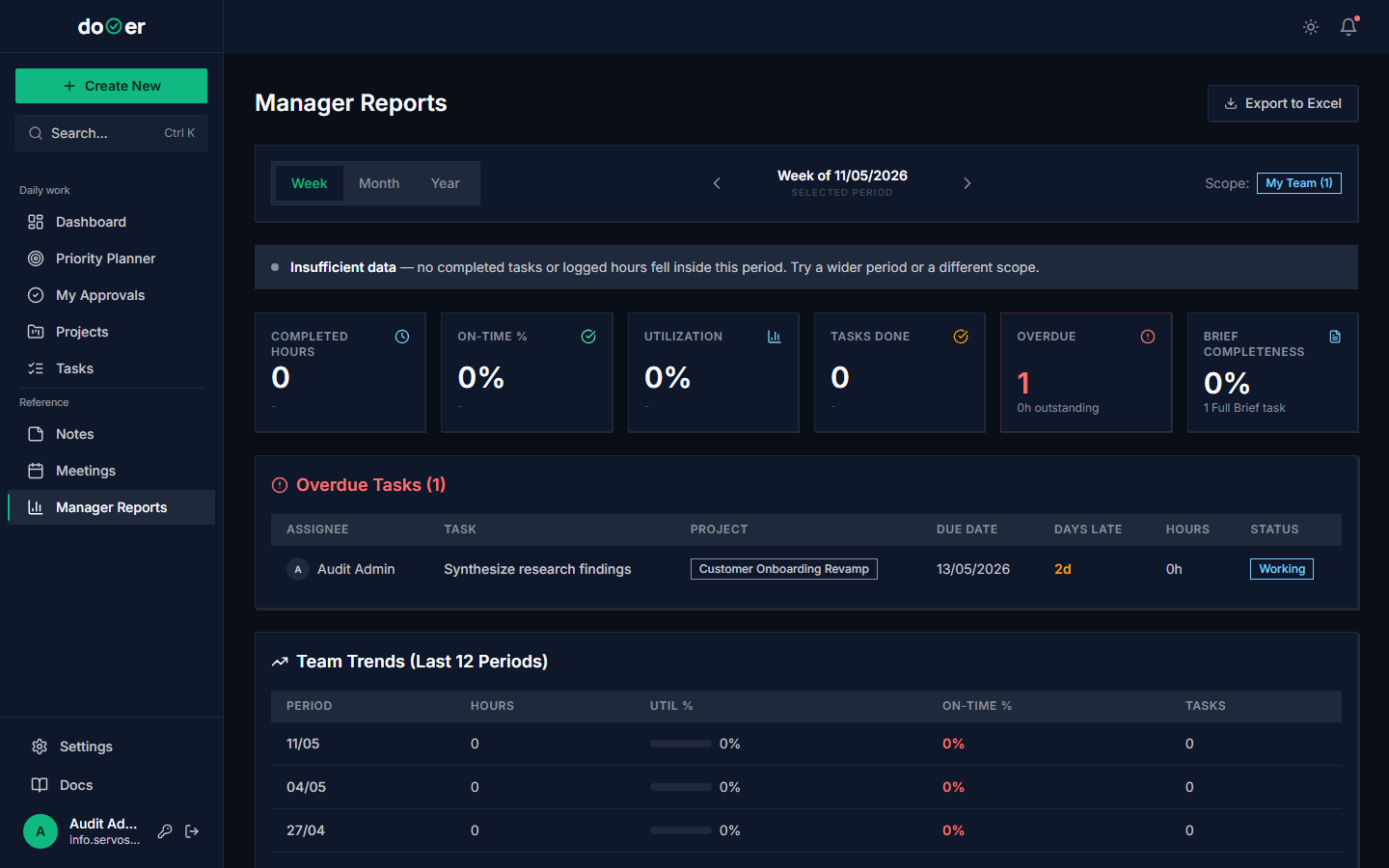 The single screen that tells you where to spend your attention this week.
- Open Manager Reports.
- Filter to all active projects.
- For each project, you need at minimum: open tasks, oldest open task age, open feedback count, last status change date.
- Save this filter as your default landing.
Color-code by attention needed
Green = on track, do nothing. Yellow = oldest task >14 days or open feedback >5; one conversation needed. Red = no status change in 30 days OR a critical blocker; intervention needed.
Concept: portfolio dashboarding. The PMI Portfolio Management Standard (PMI, 2017) describes this as "portfolio component reporting." The point is to compress N projects into one screen so you can triage in 30 seconds.
T-3.2 — Use the Audit Log as a configuration baseline
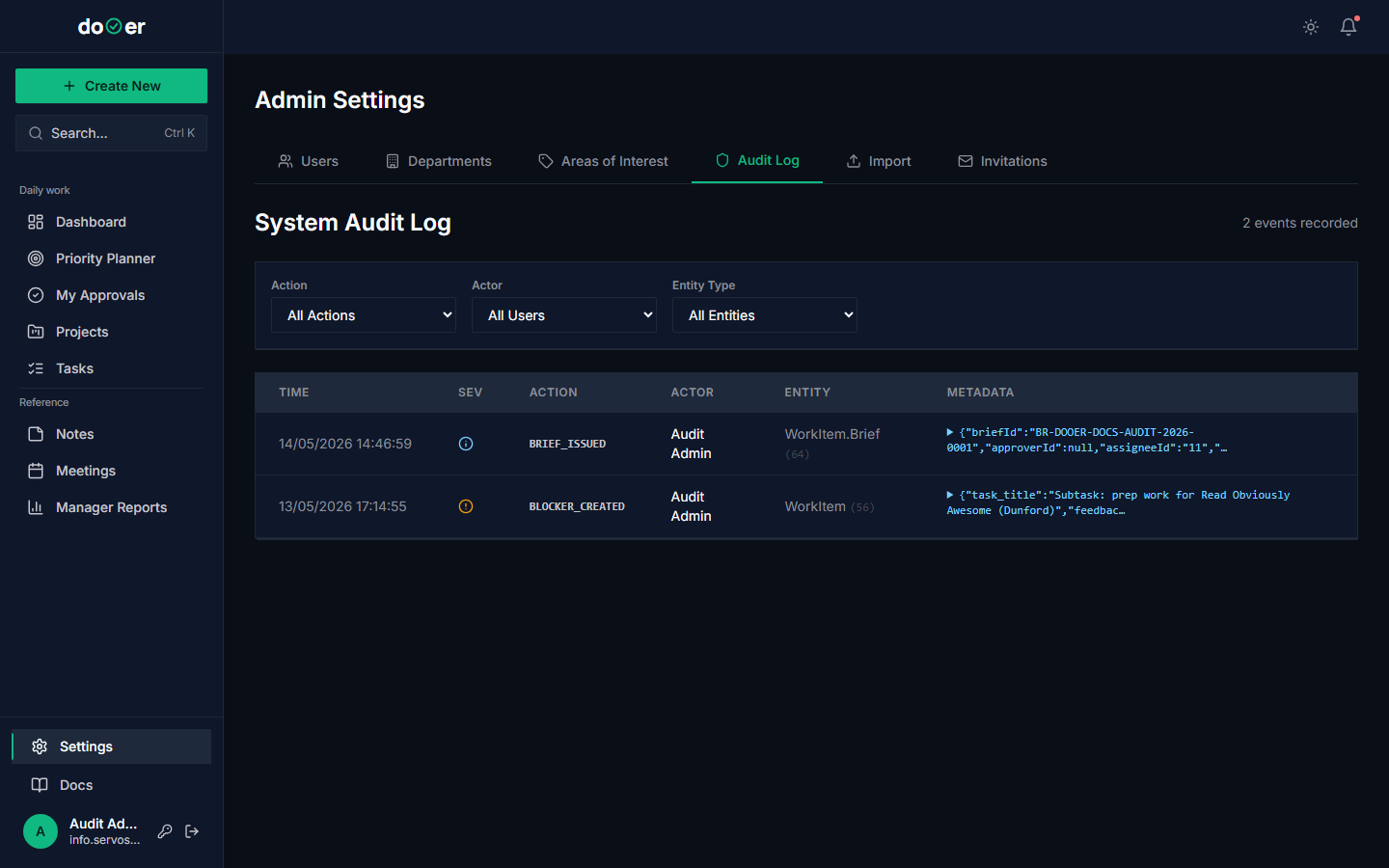 The audit log is your scope-creep early-warning system.
- Open Settings → Audit.
- Filter by one project, last 90 days.
- Look for: tasks created late (scope creep), effort revisions upward (estimate erosion), repeated reassignments (ownership fog).
- Each of these patterns is a signal — not noise.
Configuration baseline
PMBOK 7 (PMI, 2021) defines configuration baseline as "the approved version of a work product that can be changed only through formal change-control procedures." dooer's audit log is the unalterable part of this. The lessons learned register is the change record part.
T-3.3 — Tune notification policy at org level
 Set the policy once for everyone. Don't make every team member tune their own bell.
- Open Settings → Organization → Notifications (if you have admin).
- Set sensible defaults per notification kind. Suggested:
TASK_ASSIGNED,EFFORT_REVISION_*→ email + in-app.COMMENT_ADDED→ in-app only by default; emails opt-in.RESOURCE_UPLOADED→ in-app only.MEETING_SYNCED_FROM_OUTLOOK→ in-app only.
Concept: signal-to-noise ratio. Notification fatigue is the biggest threat to a working notification system. A great PMO operator cares more about which notifications fire than how many.
T-3.4 — Run a quarterly portfolio review meeting
Once per quarter, schedule a 90-minute meeting:
- Attendees: project leads (R), sponsors (A), key stakeholders (C/I).
- Agenda: for each project — health (green/yellow/red), what changed this quarter, what's next, decisions needed.
- Capture every decision (T-2.4 again).
- The output of the meeting is changes to the portfolio: kill, slow, accelerate, or hold.
What makes this different from a status meeting
A status meeting asks "what's happening?" A quarterly review asks "what should we change?" Status meetings drift. Quarterly reviews end with a list of new decisions.
Concept: portfolio choices. Roger Martin's Playing to Win (Martin & Lafley, 2013) frames strategy as a choice cascade — what will we do, what won't we do, where will we play, how will we win, what capabilities do we need, what management systems? A quarterly portfolio review is the choice-cascade refresh.
T-3.5 — Coach a direct report through the Solo track
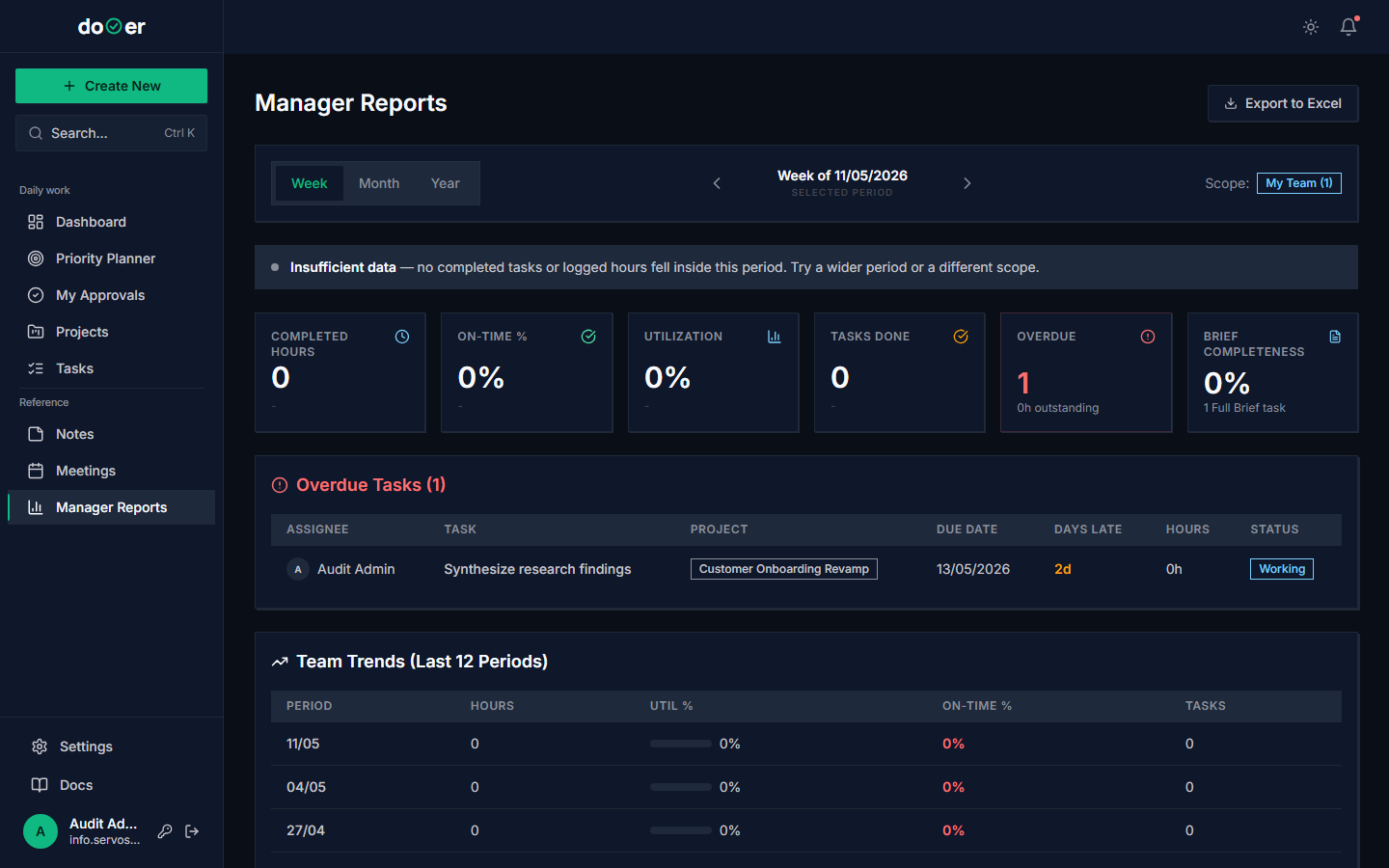 Coaching is the highest-leverage thing a Proficient lead does.
- Pair with a direct report. Look at their dooer level (novice / journeyman / expert) on their profile.
- Match them to the right Solo Operator tier. Start where they are.
- Once a week, spend 15 minutes reviewing one journey they're working on.
- When they hit a tier exit criterion, promote them publicly.
Concept: task-relevant maturity. Andy Grove (Grove, 1983) wrote that a manager's style should match the task-relevant maturity of the person doing the task — low maturity = structured/directive, high maturity = autonomous. dooer's level slugs are a literal task-relevant-maturity signal. Use them.
T-3.6 — Run an effort-estimation calibration exercise
Once a quarter:
- Pull the 20 most recent completed tasks across the team.
- For each, note: estimated effort_hours vs actual time-to-complete.
- Group by person. Compute average variance per person.
- Run a 30-min team session: share the data, discuss the patterns, agree on one calibration rule (e.g., "for tasks involving external dependency, add 50%").
Concept: reference-class forecasting. Daniel Kahneman (Kahneman, 2011) showed that the biggest cause of estimation error is the planning fallacy — we estimate as if everything goes right. The cure is comparing this task to the actual history of similar tasks. The calibration exercise builds that reference class.
See Estimation.
T-3.7 — Use dooer levels as a delegation signal
 A team member's dooer level is a real piece of data about their throughput.
When deciding who to delegate a new piece of work to:
- Look at the candidate's dooer level.
- Novice/journeyman → smaller, well-scoped work; you check in often.
- Expert+ → larger, fuzzier work; you set the outcome and step back.
- Don't assign expert-level work to novices and don't micromanage experts.
What this is not
Levels are not performance reviews. They are throughput indicators on dooer. A high-impact lead can have a moderate dooer level because they spend time on people, not on closing tasks. Use levels alongside judgement, never instead of it.
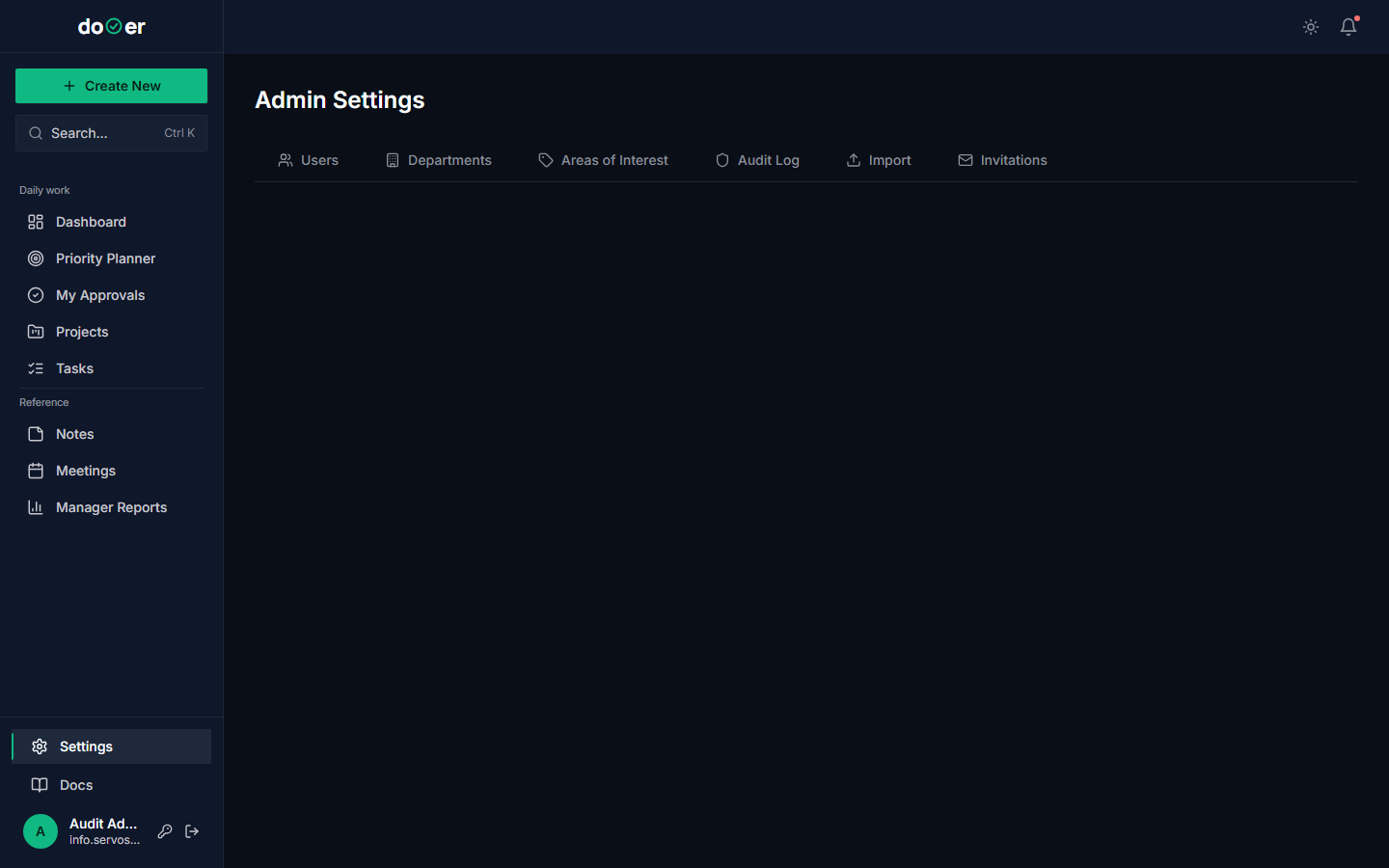
T-3.8 — Audit RBAC and integrations; remove dormant access
Once a quarter:
- Open Settings → Team. Review every member's role.
- Anyone who hasn't logged in for 90 days → remove or downgrade.
- Settings → Integrations — disconnect any integration that isn't producing value.
Concept: least privilege. NIST's Cybersecurity Framework (NIST, 2024) makes this principle one of its core controls. The PMO version: access creep over time, and dormant access is risk. A quarterly purge keeps it in check.
T-3.9 — Export and analyze externally
For the things dooer's built-in reports can't quite show:
- Export tasks XLSX, Export feedback XLSX, Export audit log XLSX.
- Load into your preferred analysis tool (Excel, Google Sheets, Tableau, Python notebook).
- Build the one view dooer doesn't have natively.
- Share back as a screenshot in a meeting, or set a recurring monthly export.
Concept: data portability. A PMO operator at this level should never feel locked into a single tool's reporting. Export discipline is the hedge.
You are now operating at PMO Director level
What's left from here is breadth — running more programmes, mentoring more leads, designing the portfolio governance for the whole organisation. dooer's curriculum stops here because the tool's surface stops here. The rest is craft you build over years.
If you've made it through both tracks in dooer, you're already operating in the top decile of operators in most organisations. The titles vary (Programme Manager, PMO Director, Chief of Staff, Head of Operations) but the work is the same.
Where the ideas come from
- PMI (2017). The Standard for Portfolio Management, 4th Edition. — portfolio component reporting.
- PMI (2021). PMBOK Guide, 7th Edition. — configuration baseline.
- Grove, A. (1983). High Output Management. — task-relevant maturity, cadence.
- Martin, R. & Lafley, A.G. (2013). Playing to Win: How Strategy Really Works. Harvard Business Review Press. — choice cascade.
- Kahneman, D. (2011). Thinking, Fast and Slow. Farrar, Straus and Giroux. — planning fallacy.
- NIST (2024). Cybersecurity Framework v2.0. — least privilege.
Full bibliography: bibliography.